Mold Remediation in Las Vegas, NV
In the desert, mold traces back to a hidden leak, not the air. The drying team finds and dry the source, then contain, remove, and verify, so it does not come back.
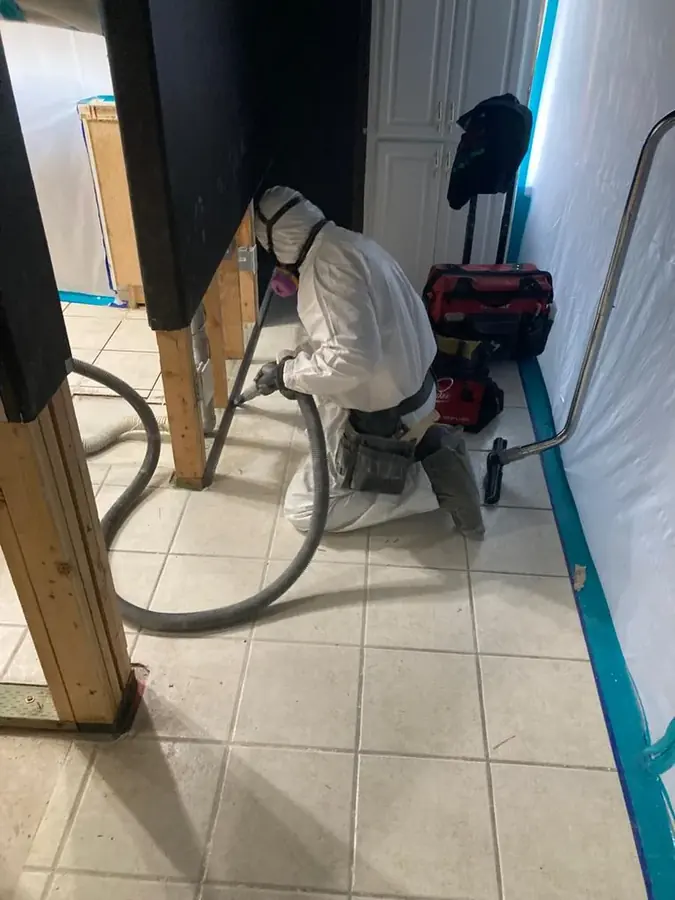
How the crew handles Mold Remediation in Las Vegas
Call & dispatch
A real valley crew answers 24/7 and the nearest team rolls with pumps, air movers, and moisture meters.
On-site assessment
The crew finds the source and moisture-maps how far the water traveled, including under tile and into wall cavities.
Extract & dry
The extraction crew pulls the standing water, then runs air movers and LGR dehumidifiers to the IICRC S500 dry standard.
Verify & document
The drying team logs moisture readings until the structure is dry, then documents the loss for your carrier.
Las Vegas is dry, so chronic humidity mold is far less common here than on the coast. When mold does show up in a valley home, it almost always traces back to water that leaked and was never fully dried: a slab leak under the floor, an AC or cooler line in the ceiling, or a supply line inside a wall. Fix and dry the water, and the mold has nowhere left to grow.
How mold starts in a desert home
Mold needs three things: a spore, a food source like drywall paper or wood, and moisture. In the desert the missing ingredient is almost always moisture, and the air rarely provides it. What does is a slow, hidden leak that keeps one pocket of the home wet long enough for mold to take hold.
- A slab leak wicking under tile and up into the base of a wall.
- An AC condensate or swamp cooler line soaking a ceiling cavity.
- A supply line weeping behind a vanity or inside a wall.
- Water from an earlier loss that was dried on the surface but not inside.
Because the source is hidden, the mold often is too, growing behind a baseboard or inside a wall for weeks before a musty smell or a stain gives it away. That is why the response team starts every job with the water, not the mold.
The mold remediation process
Remediation done right always begins with the water. If the moisture source is still active, the mitigation team stops and dry it first, because treating mold while the leak continues just means it comes back.
From there the restoration team follows the industry standard sequence. The tech who responds contains the work area so spores do not spread, remove the materials that cannot be saved, treat the surfaces that remain, and dry everything to a verified standard, the same measured dry-out the structural drying crew provides.
- Containment with poly sheeting and negative air so spores stay put.
- HEPA filtration and controlled removal of moldy porous material.
- EPA registered antimicrobial treatment of the surfaces that remain.
- A final check to confirm the area is dry and clean before the local restoration pro closes it.
Mold and your health
Not all mold is toxic, and the term black mold gets used loosely. Some molds do produce irritants that bother the eyes, skin, and lungs, and people with asthma or allergies tend to feel it first. The practical point holds either way: mold does not belong indoors, and the fix is to remove it and control the moisture that fed it.
The EPA and the CDC guide to mold cleanup make the same point: whatever the color, indoor mold should be cleaned up and the moisture problem corrected. Testing is not always necessary. When you can see or smell mold, remove it and dry the source. Testing makes more sense when the extent is unclear, or a sale or a claim calls for documentation.
Preventing mold after water damage, and insurance
The best mold job is the one that never has to happen, and speed is the whole game. Dry wet material within 24 to 48 hours, keep indoor humidity under 60 percent, and fix leaks while they are small. A water loss handled quickly and dried to a real standard rarely turns into a mold problem at all.
Insurance treatment of mold varies. When mold results from a sudden covered loss that was addressed promptly, remediation is often covered, while mold from a long ignored leak frequently is not. Water Damage Removal Las Vegas documents the source and the work for your carrier.
Found mold from a hidden leak? Call now. A crew can assess the moisture source and the mold, then handle both the right way.
☎ Call (702) 478-2029How a Las Vegas water loss is handled
Rapid local response
A Las Vegas water damage pro picks up the line 24/7, any hour of the night.
Valley-wide dispatch
Crews cover Clark County, from Summerlin to Henderson, day or night.
IICRC S500 drying standard
Structural drying to the IICRC S500 standard, not just surface drying.
Claim-ready documentation
Timestamped photos and daily moisture logs, so the claim file has what an adjuster needs.
Structural rebuild
Nevada contractors handle the structural rebuild after drying.
Water damage coverage across the whole Las Vegas valley.
The Las Vegas water damage pros dispatch valley-wide across Clark County. Here is the coverage, down to the ZIP.
The Las Vegas water damage pros cover the whole valley and Clark County, day or night, with rapid local response.
Coverage includes Summerlin, Henderson, North Las Vegas, Spring Valley, Enterprise, Green Valley, Centennial Hills, Paradise, and Downtown.
See every neighborhood and ZIP covered ›