Storm and Monsoon Damage Restoration in Las Vegas, NV
Monsoon microbursts drive rain through valley roofs. The crew tarps, extract, and dry the intrusion, then coordinate the repairs, with crews on-site day or night.
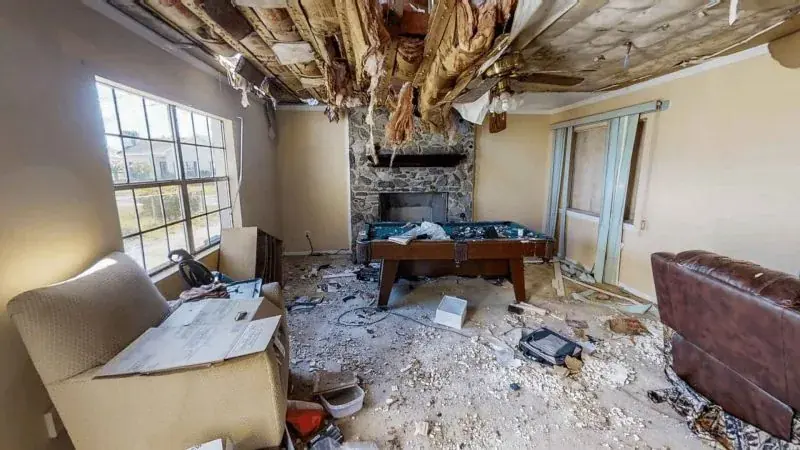
How the crew handles Storm in Las Vegas
Call & dispatch
A real valley crew answers 24/7 and the nearest team rolls with pumps, air movers, and moisture meters.
On-site assessment
The crew finds the source and moisture-maps how far the water traveled, including under tile and into wall cavities.
Extract & dry
The extraction crew pulls the standing water, then runs air movers and LGR dehumidifiers to the IICRC S500 dry standard.
Verify & document
The drying team logs moisture readings until the structure is dry, then documents the loss for your carrier.
The Las Vegas monsoon does its damage two ways. On the ground it floods, and from above it drives rain through your roof. Between July and September, microbursts and haboobs push wind-driven rain sideways into roofs, parapets, skylights, and window seals across the valley. The extraction crew tarps, extract, and dry the intrusion, then coordinate the the repairs.
The Las Vegas monsoon season
Monsoon storms are short, violent, and hard to predict. A clear afternoon can turn into a downpour with 60 mile per hour gusts in under an hour, and the same cell that floods a wash can strip a roof a mile away. The smart response is to call at the first sign of a leak rather than wait to see how bad it gets.
- Microburst downdrafts that top 60 miles per hour and lift or peel roofing
- Haboobs, a wall of blown dust ahead of the storm, that pack grit into roof seams
- Brief, intense downpours that overwhelm roof drains and scuppers
- The same cells that cause valley flash flooding at ground level
The National Weather Service in Las Vegas tracks these storms all summer, and their warnings are the best few minutes of notice the valley gets before a cell hits.
Storm water intrusion the response team restores
Wind-driven rain does not fall straight down, it comes in sideways and finds every seam. On the flat and low-slope roofs common across the valley, the water gets in at the edges and the penetrations first, then sits and works its way through the membrane rather than running off the way it would on a steep roof.
- Roof leaks where wind lifted shingles, tiles, or flat-roof membrane
- Parapet and scupper leaks on flat desert rooftops
- Skylight and window-seal leaks from sideways rain
- Ceiling stains and drips that spread through insulation and drywall
Water that comes through the roof lands in the same places a ceiling leak does, and it needs the same fast drying before it spreads across the ceiling and down the walls.
The storm response
Storm work is a race to stop the water, then dry what it already reached. The mitigation team splits it into an emergency phase and a restoration phase so the damage stops growing the day the restoration team arrives.
- Emergency tarping and board-up to stop the water coming in
- Extraction of standing water and saturated insulation
- Structural drying of the roof deck, ceiling, and walls with daily readings
- Coordination with Nevada contractors for the roof and structural repairs
For the ground-level pump-out after the same storm, the flood and flash flood cleanup crew handles the garages and ground floors, so one call covers both the water from above and the water below.
The tech who responds keeps the emergency phase and the drying under one roof, so the tarp goes up, the water comes out, and the structure dries without a gap where the damage can keep spreading.
Storm claims and getting started
Sudden monsoon storm damage, like wind-driven rain through a roof the storm just opened, is frequently covered. The local restoration pro photographs the intrusion before the crew tarps and write the scope your adjuster expects, so the sudden cause is clear and the claim keeps moving.
Preparedness pays off before the season starts. The Nevada Division of Emergency Management publishes seasonal storm and flood guidance worth reading before July, and a roof looked over each spring is far less likely to leak in the first hard cell.
A monsoon storm is coming through. Call now and a valley crew is on the way.
☎ Call (702) 478-2029How a Las Vegas water loss is handled
Rapid local response
A Las Vegas water damage pro picks up the line 24/7, any hour of the night.
Valley-wide dispatch
Crews cover Clark County, from Summerlin to Henderson, day or night.
IICRC S500 drying standard
Structural drying to the IICRC S500 standard, not just surface drying.
Claim-ready documentation
Timestamped photos and daily moisture logs, so the claim file has what an adjuster needs.
Structural rebuild
Nevada contractors handle the structural rebuild after drying.
Water damage coverage across the whole Las Vegas valley.
The Las Vegas water damage pros dispatch valley-wide across Clark County. Here is the coverage, down to the ZIP.
The Las Vegas water damage pros cover the whole valley and Clark County, day or night, with rapid local response.
Coverage includes Summerlin, Henderson, North Las Vegas, Spring Valley, Enterprise, Green Valley, Centennial Hills, Paradise, and Downtown.
See every neighborhood and ZIP covered ›